
WaveAssist
Published on: Apr 24, 2026
Deterministic AI agents vs agentic AI agents is the defining architecture choice of 2026. One runs the LLM once at build time, the other re-thinks every step at runtime. The bet decides your cost, your reliability, and whether your agent still works a year from now.
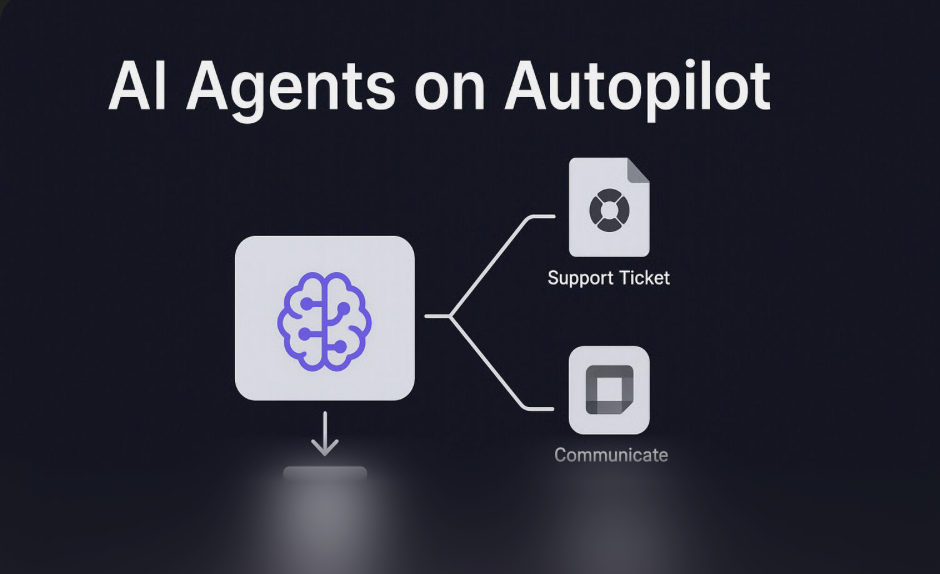
Every "AI agent" product on the market is making one of two bets, and the founders usually can't articulate which. The bet determines whether your agent costs $2 or $200 per run, whether it works the same way twice, and whether it will still be running a year from now.
It's worth naming.
Fat-harness, agentic. The LLM decides every step at runtime.
The agent re-thinks the workflow on every invocation. Every run is a fresh plan. Every plan costs tokens. Every step is an opportunity for the model to go somewhere new.
Thin-harness, deterministic. The LLM designs the pipeline once, at build time. Then code runs forever. The model gets called only for the specific steps that actually need judgment.
One approach puts the intelligence inside the loop. The other puts the intelligence behind the loop.
This isn't a stylistic argument. It's a reliability argument with a paper trail.
The top coding models (GPT-5, Claude Opus 4.1) score ~70% on SWE-bench Verified and collapse to 23% Pass@1 on SWE-Bench Pro (Sept 2025, arxiv 2509.16941), the long-horizon, multi-file variant. On commercial subsets it drops under 20%.
Agentic loops on long tasks fail most of the time.
You cannot run a business on 23%.
You can, however, run a business on a deterministic pipeline that calls a 70%-reliable model for one well-scoped step, validates the output, and retries. The surface area where the model can fail is smaller by construction.
The people with no stock in the outcome are waving the same flag.
Simon Willison (Jan 2025):
"I think we are going to see a lot more froth about agents in 2025, but I expect the results will be a great disappointment to most of the people who are excited about this term."
Hamel Husain:
"Be deeply skeptical of features that promise full automation without human validation… this stacking of abstractions often hides flaws behind a high score."
Two of the most respected practitioners in the space, and neither is bullish on fat-harness agents. That matters.
If you want the cleanest signal, watch what the labs do, not what they say.
December 18, 2025. Anthropic launched Agent Skills: "organized folders of instructions, scripts, and resources" that agents load dynamically. It shipped as a cross-industry standard with Atlassian, Canva, Cloudflare, Figma, Notion, Ramp, and Sentry.
Read that again.
The lab most associated with "agents" in the public imagination did not respond to reliability problems with a smarter agent. It responded with codified, file-backed, deterministic workflows. Instructions and scripts. Resources on disk. Predictable loading, predictable behavior.
That's the bet. The smartest shop in the category chose thin harness.
WaveAssist picked a side, and we picked it early.
Every agent we ship, GitZoid, GitDigest, SentimentRadar, WavePredict, PatternAnalyser, is a compiled pipeline, not a runtime loop. The expensive part happened once, at the start. Everything after is deterministic.
This is why our agents cost what they cost. This is why they still run a year later. This is why the cron job doesn't come back.
The agent space isn't splitting into winners and losers on model quality.
It's splitting on architecture.
The thin-harness side is where production lives. It's where Anthropic quietly moved when the reliability numbers came back. It's where the skeptics are pointing. It's where the economics work.
The fat-harness side is where demos live.
Pick your bet. Then ask your vendor which one they made. If they can't answer clearly, that is the answer.
→ Want to see a deterministic AI agent in production? Explore WaveAssist or deploy a prebuilt assistant in 5 minutes.
Browse production-ready AI agents you can launch in one click.
Explore AI AssistantsPick a deterministic AI agent, configure it once, and let it run on schedule, forever. $2 in starter credits, no credit card needed.


